Counting what you can see
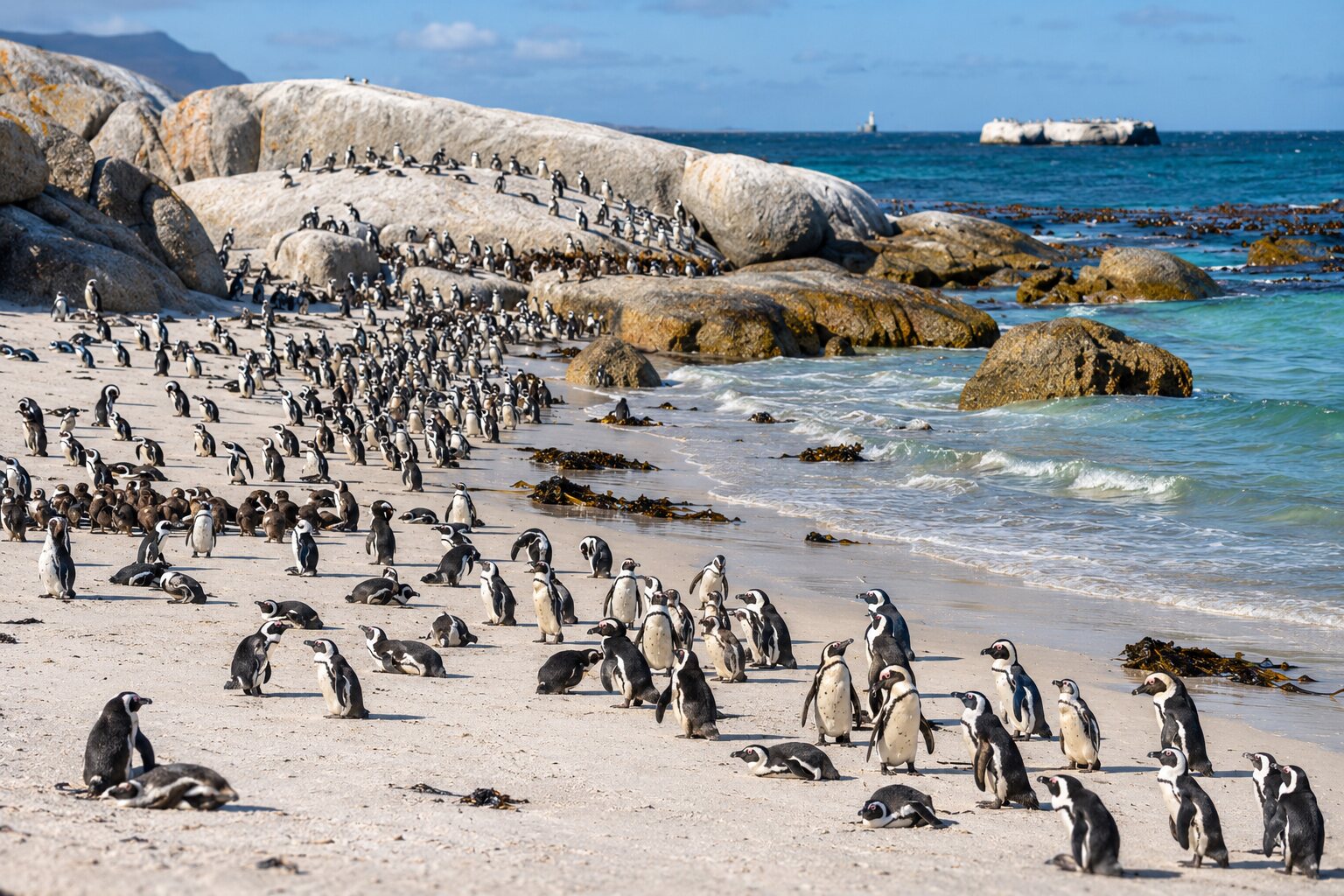
For penguins that nest in the open, like Adélies and chinstraps, researchers still count nests directly. Where a colony is small they tally every occupied nest by eye; where it is vast, they count a series of marked plots or strips and scale up to the whole area. Because the number of active nests maps closely to the number of breeding pairs, a careful nest count is the single most useful figure a colony can give.
Eyes in the air
Larger and more remote colonies are now photographed from above. Drones fly low, grid-by-grid passes and stitch the images into a single high-resolution map that can be counted frame by frame — far more accurate, and far less disturbing, than people walking through the birds. From much higher up, satellites pick out colonies by their guano: the pink-brown stain a colony leaves on the ice or rock is visible from orbit, and has revealed emperor colonies no one knew existed.
Counting what you cannot see
Burrow-nesters like the little penguin and the Magellanic hide their nests underground, so a surface count misses most of the colony. Instead, researchers survey burrows — checking a sample for occupancy with a careful look or a burrow camera — and estimate how many of the total holes are active. It is slow work, and the reason burrow colonies are among the hardest to census accurately.
Following individuals
To understand not just how many birds there are but how they are faring, scientists track individuals over time. Tiny PIT tags — the same technology as a pet microchip — let automated gates log a known bird every time it crosses the beach, recording how often it feeds its chick and whether it survives the winter. Satellite and GPS tags, carried briefly, map where the birds go to hunt, revealing the fishing grounds a colony depends on.
Why the numbers matter
None of this is counting for its own sake. A run of annual counts is what turns a vague worry into evidence — showing, for instance, that the African penguin has collapsed, or that a protected colony is holding steady. The figures decide where marine reserves are drawn, which colonies get round-the-clock wardens, and whether a species is listed as endangered. Behind every population number is a season of patient fieldwork.